

Sheikh Mohammed lays foundation for Dubai Metro Blue Line (VIDEO)
Major expansion to connect key urban hubs with 14 new stations by 2029
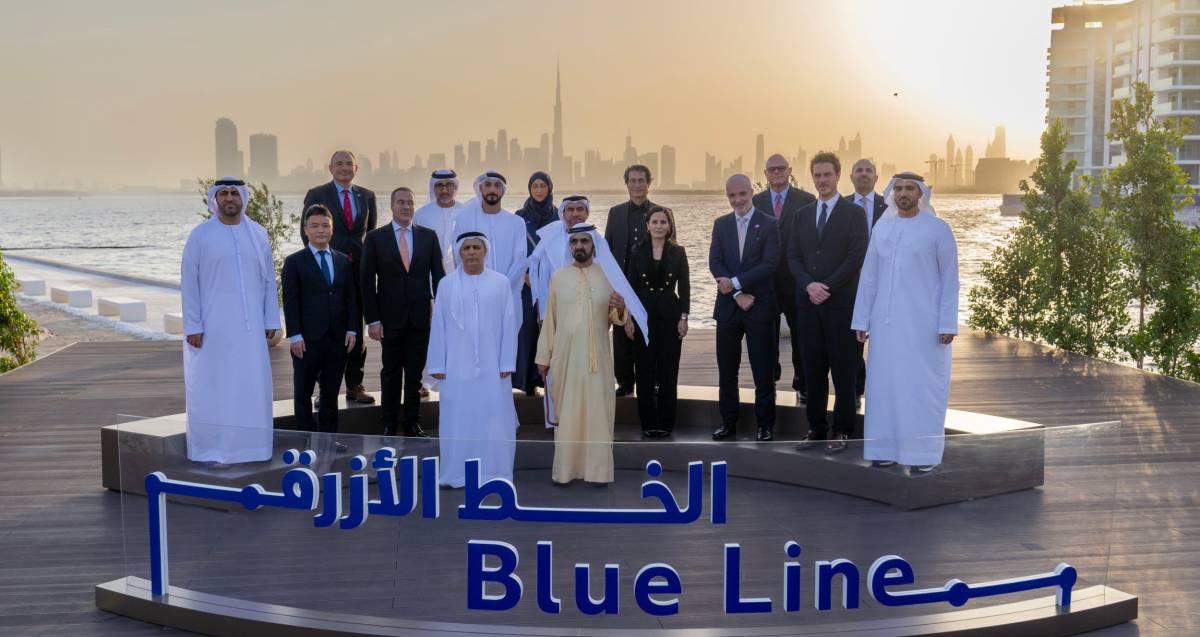
DUBAI: His Highness Sheikh Mohammed bin Rashid Al Maktoum, Vice‑President and Prime Minister of the UAE and Ruler of Dubai, today attended the foundation‑stone ceremony for the Dubai Metro Blue Line.
The 30 km rapid‑transit route will introduce 14 new stations across nine districts – including Dubai Creek Harbour, Academic City and Dubai Silicon Oasis – and aims to serve approximately one million residents by 2040, in line with the Dubai 2040 Urban Master Plan.
The Blue Line marks the first Dubai Metro route to cross Dubai Creek via a 1.3 km viaduct, seamlessly linking the Red Line at Al Rashidiya’s Centrepoint Station and the Green Line at Creek Station in Al Jaddaf. This integration promotes the ‘20‑minute city’ vision, ensuring 80 % of key services are within easy reach.
World's tallest metro station
At the ceremony, the Dubai Ruler approved the architectural design of the Emaar Properties Station, set to become the world’s tallest metro station at 74 m high and 38 m wide. Designed by Skidmore, Owings & Merrill (SOM) – the architectural firm behind Burj Khalifa, New York’s Olympic Tower and Chicago’s Sears Tower – the station occupies 11,000 m² and is engineered to accommodate up to 160,000 passengers daily, with utilisation projected to surpass 70,000 per day by 2040.
A visual model showcased a luminous central gateway allowing natural light to flow to platform level, with premium materials including Jura limestone, bronze panels and granite flooring – all curated for durability and elegance . Emaar Properties has secured naming rights for a decade from the station’s grand opening in 2029.
Dubai Metro Blue Line
This metro extension raises Dubai’s total rail network to 131 km, with 78 stations and 168 trains (157 metro and 11 tram units) in operation once the Blue Line opens. Ridership on the Blue Line is expected to reach 200,000 daily by 2030 and 320,000 by 2040, delivering an infrastructure capable of handling over 850,000 travellers at peak capacity.
Dubai Metro has been steadily growing since 9 September 2009, now surpassing 2.527 billion passengers transported through 2024, with a daily average of 900,000 last year. Forecasts point to over 300 million passengers by 2026 and nearing 320 million by 2031.
Fuelled by the September 2029 opening date, the Blue Line is built on an Dh18 billion to Dh56 billion budget – estimates vary – promising a benefit‑cost ratio of 2.6 by 2040 under Dubai Economic Agenda D33. Expected advantages include 20 % reduction in traffic congestion, up to 25 % uplift in nearby land values and significant savings in time, fuel and carbon emissions.
What routes will the line take?
The Blue Line comprises two branches: the 21 km elevated/underground stretch from Creek Station – via Dubai Festival City, Dubai Creek Harbour, Ras Al Khor and International City 1 – to Academic City, serving ten stations. The 9 km branch runs from Centrepoint Station through Mirdif and Al Warqa to International City 1, where both branches converge at an underground interchange. A new depot will be built at Al Ruwayah 3 beyond Academic City.
Projected travel times are around 25 minutes from Creek to Academic City and approximately 17 minutes from Centrepoint to Academic City.
How eco‑friendly is the design?
Dubai Metro Blue Line is the first metro project in the emirate to receive Platinum‑level green building certification. Every station features integrated bus bays, taxi zones, bicycle and e‑scooter racks, and accessible facilities. The Emaar station showcases a lighting scheme that brilliantly alternates from natural daylight to a radiant nighttime beacon.
Sustainable, durable materials and efficient layouts aim to reduce both capital and operational costs while creating a sense of place that reflects Dubai’s legacy and landscape.
The Roads and Transport Authority confirms that the Blue Line supports Dubai’s ambition to become the world’s best city to live in, aligning with Dubai 2040’s transit‑oriented development model and D33 goals.